Two hundred and ninety-eight verses, and you are already free.
A boy-sage teaches a king. Sanskrit, plain English and Ashoka's reflection on every verse, at your pace, in any order.
What the Ashtavakra Gita is
A king asks three questions. How does one come to know? How does one become free? How does one let go? A boy-sage answers him, and keeps answering for twenty chapters. That is the whole of the Ashtavakra Gita, also called the Ashtavakra Samhita. It is one of the purest statements of non-duality (Advaita) ever written. It offers no ritual and no method. It says one thing, in two hundred and ninety-eight ways: you are the witness, and you are already free.
The boy behind the name
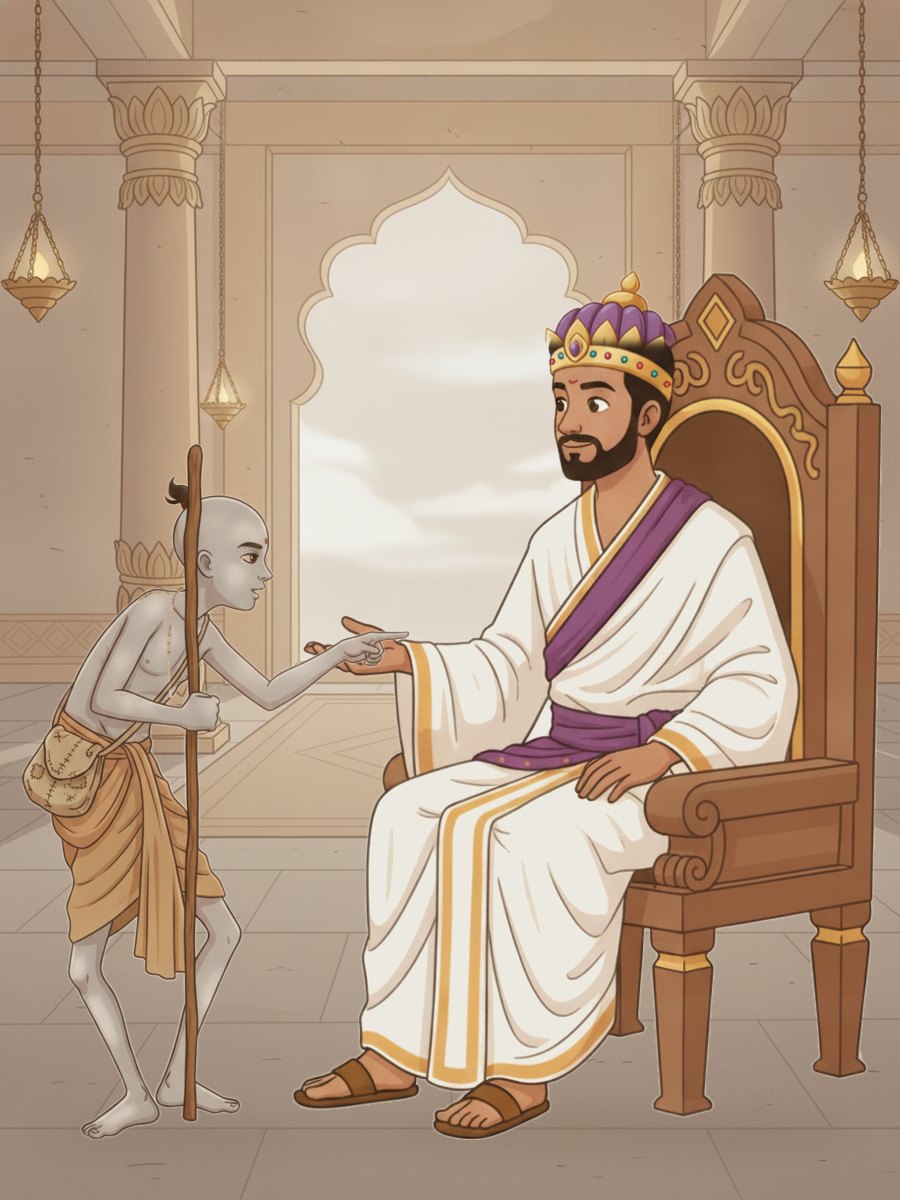
His name means "eight bends". The Mahabharata tells why. His father, Kahoda, was reciting scripture late into the night, and the child in the womb corrected his mistakes. Stung, the father cursed him to be born crooked in eight places. Later, Kahoda went to King Janaka's court to win money for his family. There he lost a debate to the court scholar Bandi (Vandin in the translation we quote), and was cast into the water. No one told the boy.
His story in six short films
Told by Ashoka · about 5½ minutesIn his twelfth year he learned the truth, and set out for Janaka's court with his uncle Svetaketu, a boy his own age. A warder barred the way: only learned old scholars may enter. Ashtavakra replied that growth is not measured by the body, and that "a fire, small though it be, burneth on being touched." He was let in. He defeated Bandi in debate.
Then came a surprise. Bandi was the son of Varuna, the lord of the waters, and the scholars he had "drowned" had been sent to Varuna's own twelve-year sacrifice. They came back, Ashtavakra's father among them. On the way home, his father told him to bathe in the river Samanga. As he went under, his limbs were made straight.
A much-loved later retelling, not found in the Mahabharata, adds a scene in the king's hall. The court laughs at the bent boy. He laughs back: he had come to an assembly of the wise and found only men who judge a person by the skin.
The Ashtavakra of these pages is the boy who walked into that court, before the river. The body was never what he was. That is also what he teaches.
Janaka, the king who listened
Janaka was a name carried by a line of philosopher-kings of Videha, whose capital was Mithila. Sita's father in the Ramayana was one of them. The Brihadaranyaka Upanishad shows another learning from the sage Yajnavalkya. Which Janaka met Ashtavakra, no one can say, and the old commentators asked the same question.
What they share is a reputation: kings who ruled fully and were inwardly free. The Bhagavad Gita says so in Krishna's own words. "Janaka and others attained perfection verily by action only" (3.20). Here you meet that king at the moment he asks, and then you hear him answer from his own awakening.
Why it has lasted
No one knows when it was written. Guesses span many centuries, and most modern scholars place it in the medieval period. What is clear is who has loved it.
Sri Ramakrishna kept a copy in his room and asked the young Narendra, later Swami Vivekananda, to read it aloud. Narendra would read a verse or two and stop, saying it was a sin to call man God. Ramakrishna asked him only to read on, without accepting a word. The book shaped the rest of his life.
Ramana Maharshi copied the text out in his own hand and spoke of Janaka's awakening with his visitors. In 1976 and 1977, Osho gave ninety-one talks on it in Hindi, published as the Mahageeta, and brought it to a new generation of readers in India and abroad.
Why this sits beside your chart
Everywhere else on this site, Ashoka reads your chart. The chart describes the one who acts: your temperament, your timing, the shape of your karma. This text points to the one who watches all of that. It says the watcher was never bound. Both are true at different depths. Read your chart to live your life well. Read Ashtavakra to remember who is living it.
How we read it here
Every verse carries its Devanagari Sanskrit, a transliteration and an English translation. The English is John Richards', which he gave to the public domain, and we never alter it. We checked the Sanskrit line by line against two scholarly editions and corrected it where it had slipped. Beneath each verse, Ashoka offers a short reflection in plain words. It is written as a study companion, never as a guru's decree. Read more about our approach →
Start each chapter with Ashoka
Each of the twenty chapters opens with a short note from Ashoka: what he sees in it, and what it asks of you.